EXORBITANT CLAIMS BY IPPC IN THE SUMMARY FOR POLICY MAKERS
According to the IPCC the global mean sea level has risen by approximately 15-25 cm (6-10 inches) between 1901 and 2018. This rise is attributed to a combination of factors, primarily melting glaciers and ice sheets, and thermal expansion of seawater as it warms. The warnings are stark. “It is virtually certain that global mean sea level will continue to rise over the 21st century,” wrote scientists in the August 2021 report of the United Nations Intergovernmental Panel on Climate Change (IPCC), the key UN scientific body focusing on this crisis. The fundamental reason for rising sea levels is global warming caused primarily by human use of fossil fuels. Warming causes ice sheets and glaciers to melt, increasing the volume of water in the oceans. Plus, warming causes the water to expand. Sea level rise in the 20th century was the highest 100-year increase in the past 3,000 years, rising 20 centimeters (7.9 inches) between 1901–2018, according to the UN IPCC Scientists measure overall change in the oceans by calculating what they call global mean sea level (GMSL) – the average height of the entire ocean surface. GMSL “has accelerated since the late 1960s,” according to the IPCC, but has been on the rise for at least a century.
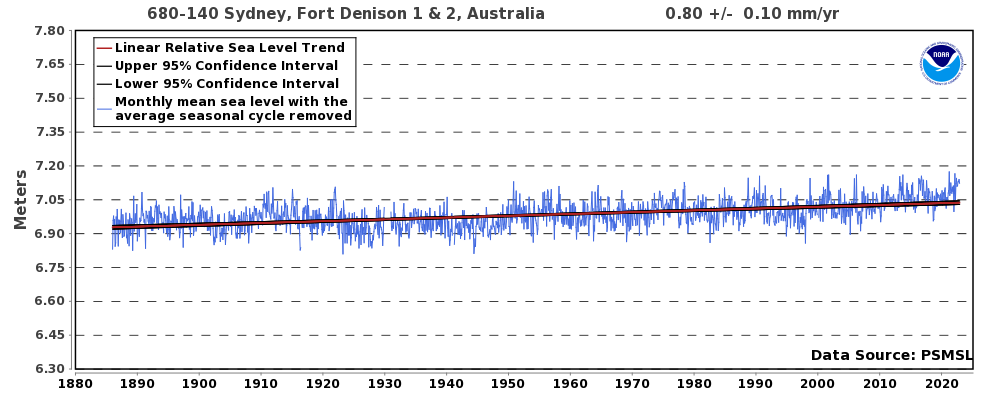
However, according to data from NOAA, the current sea level trend at Fort Denison in Sydney, NSW is rising at a rate of approximately 0.75 millimeters per year, which translates to a change of 0.26 feet per century. This comes from reliable sea level data recorded all the way back to 1886 at Fort Denison 1 & 2 according to the NOAA website. The plot shows the monthly mean sea level without the regular seasonal fluctuations due to coastal ocean temperatures, salinities, winds, atmospheric pressures, and ocean currents. Relative Sea Level trends at the coast can be positive or negative. A negative trend does not mean the ocean surface is falling; Indicating land might be rising more quickly than the ocean.
The 170 world tide gauges with more than 60 years of data recorded in the PSMSL data base presently showing a relative rate of rise of about +0.403 mm yr–1, constant, very likely the result of more subsidence than isostasy at the tide gauge locations, for an average absolute rate of sea level rise very close to zero.
3 Comments
Four inches in 100 years is not going to worry anyone except the IPCC whose predictions were designed to help prove that global warming was the cause of sea level rise.
Their so called global warming could fall apart. According to NASA the 1990 global temperature was measured at 15.45 degrees Celsius, 0.25 C warmer than 2024 at 15.20 C. To their credit NASA has not altered its temperature data.
When will this Tommy Rot end? They have always found something for us to be afraid of and its always our fault like the build up of carbon dioxide from the fires that we needed to cook our meals and help keep us warm and at pretty much the same time they warned us about the diminishing of the ozone layer…when will we ever learn?