PLASTIC EV’S NOT PLANET FRIENDLY
While electric cars can be up to 50% plastic and only contribute to about 10% of an electric car’s total weight, the claim that they are more energy efficient and environmentally friendly, needs further scrutiny. The greater use of plastics will improve the weight to power ratio over its metal counterparts but the comparison should not end there. Plastics and metal components are both manufactured from fossil fuels but only metal parts can be reused whereas the majority of discarded plastic is either burned (as in south east Asia), buried or finishes up in our oceans and waterways. Scientists have found micro plastics in our ocean food chain and discovered them as far north in the Arctic circle snow which should be a wake up call for world health authorities.

We still don’t know how we can safely dispose the hundreds of acres of Solar panels when they exceed their life span, burying them will create a major problem because they will leach their contaminates into the soil.
Nor is it clear whether the safe recycling of electric car batteries, will be possible. Considering the first wave of EV’s hit the market roughly a decade ago the world is starting to wonder, “Can lithium batteries be safely recycled?”, pondering the environmental impact and how to undertake environmentally friendly electric car battery disposal will be a major issue. With the International Energy Agency predicting an 800 percent increase in EVs over the next decade, electric car battery recycling will soon become a major issue for those wanting to avoid battery waste and disposal pollution. The infrastructure to support the mass disposing of lithium batteries and their eventual recycling is yet to be discovered.
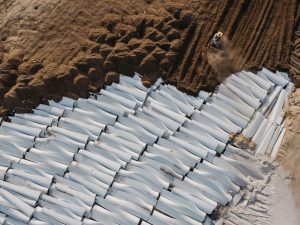
Turbine Burial
Wind turbines, when they reach their expiry date, can be safely buried in remote areas. But there will be further problems for Australia when the high emissions generated by the manufacturing of both Solar panels and Wind Turbines in overseas countries will cause Australia to be held accountable for the “emissions at a distance”.
3 Comments
I cannot understand why the UN are not doing anything about reducing the plastics that are smothering our planet. The doctor who attended me following my recent bout of Covid-19 told me that without plastics a hospital may as well close down. Our glut of plastic – every single bit of it ever made is still with us apart from the minor portion that has been burned – has come to symbolize a throwaway world. The amount of plastic produced in a year is roughly the entire weight of the human beings living upon it.
The oceanic Great Pacific Garbage Patch of floating plastic is three times the size of France.2 Coca-Cola alone sends out 120 billion plastic bottles each year – enough to circle our planet 700 times.1 We discard this stuff, often without a second thought, but also because there is so much of it and it just keeps coming – either as packaging for the things we buy or as the throwaway things themselves.
Bakelite should replace plastic…..It’s not hard!
It’s manufacture produces emissions three times less than plastic
As far as environmental protection is concerned, Bakelite is a good student. Often classified as plastic, it is actually derived from biosourced raw materials: 40% comes from wood cellulose and 60% from renewable elements like the air, water, and urea, a fertilizer widely used all around the world.
To strengthen their environmental commitment, five years ago, Technicaps launched a broad plan based on the 3R strategy (Reduce, Reuse, Recycle). This approach helped reduce water consumption by four, but also boost production without increasing power consumption. “We have evidence that for the same production level, between 2013 and 2018, we gained about 15g of CO2 per unit produced, and we produce 56 million a year,” claims Arnaud Revel.
Bakelite is not an alternative to plastics. What we must do is to convert plastic back to oil or diesel/petrol fuel using the Pyrolysis Method. There are concerns about the energy required to operate the plant but it is hardly an issue when you look at what the plastics are doing to our marine environment. duh-duh